


[fblike]
 Chicago is the third-largest city in the United States. Home to more than 2.7 million people, it is battling some of the same crises as other major urban centers in the country: declining population, poorly performing public schools, high crime, and a growing pension crisis. On April 7, Chicago voters went to the polls to participate in the first mayoral runoff since the city moved to nonpartisan mayoral elections in 1999. The battle was framed as an internal Democratic Party struggle that pitted Mayor Rahm Emanuel, a centrist, against progressive Cook County commissioner Jesus “Chuy” Garcia. After the votes were tallied, Emanuel won re-election by a comfortable 56-44% margin, but doing so cost millions of dollars and the fact that the election went to a runoff, especially after Emanuel’s biggest challengers dropped out of the race prior to the first round of voting, was deemed as a blow to Emanuel’s political reputation. Emanuel must now deal with the city’s economic problems, its teachers’ union, and a city council that is growing more progressive. His success in doing so may determine whether he is able to achieve higher national office in the future.
Since “state and local issues” are an important facet of United States Extemp at the National Speech and Debate Association (NSDA) National Tournament, this topic brief will provide a summary of the major issues in the Chicago election, explain why Emanuel was able to win, and then analyze the fiscal challenges Emanuel will face over his next term.
Readers are also encouraged to use the links below and in the related R&D to bolster their files about this topic.


 When he was elected in 2008, President Barack Obama went to great lengths to convince voters and the rest of the world that he would not continue many of the foreign policies of George W. Bush. Bush’s presidency is most remembered for the war in Iraq, a campaign that cost thousands of American lives and destabilized the Middle East. However, while the war in Iraq dominated the headlines, the prospects of a nuclear Iran also loomed over the region. In 2002, Iranian dissidents revealed that the Islamic Republic was pursuing a covert nuclear program. Since that time, the United States and its European partners, as well as China, have worked to contain the country’s nuclear ambitions, imposing sanctions to force the Iranian government to the negotiating table. In 2013, Iran agreed to an interim accord that saw it agree to restrictions on its nuclear program in return for some sanction relief. The United States hopes to have an agreement with Iran by June, thereby averting military action and possibly beginning the restoration of diplomatic relations between the two countries.
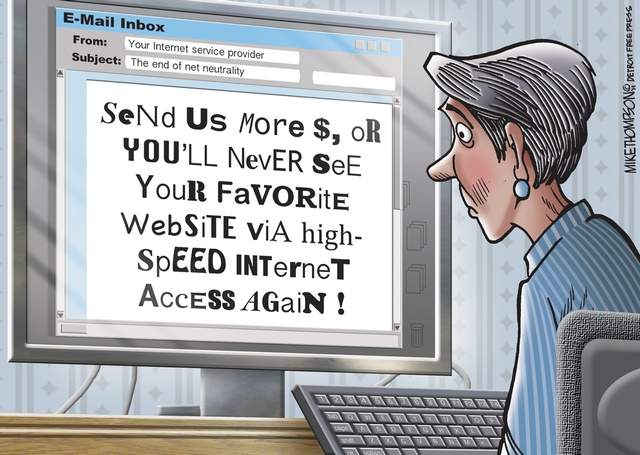 Last Thursday, the Federal Communications Commission (FCC) on a party-line vote decided to reclassify broadband as a telecommunications service. This allows the FCC to impose more regulations on broadband Internet providers as if they were a public utility. The FCC intervened due to concerns that Internet Service Providers (ISPs) will discriminate against network traffic, speeding up some Internet sites that would be willing to pay them a special fee, while reducing the speeds of other sites that either refused to pay or were in competition with other operations of the ISP. This so-called “net neutrality,” which treats all Internet data the same, has become a highly charged political issue, with conservatives warning that the FCC’s decision will stifle innovation and liberals championing the FCC’s decision as a victory for consumer interests.
 Domestic extempers can attest to the fact that questions about education reform never go away. From merit pay to vouchers to standardized testing, extempers must be able to handle topics pertaining to the American education system if they wish to successfully navigate domestic social rounds. Anxieties about American education have persisted since the nation’s founding, with President Thomas Jefferson warning that “If a nation expects to remain free and ignorant in a state of civilization, it expects what never was and what never shall be.” Americans have desired a strong education system to maintain the nation’s position as a political and economic superpower, enhance socioeconomic mobility and the “American dream,” and to solve social ills such as racial and gender inequalities. However, despite the federal government pouring more money into American schools since the 1960s, American students still lag behind their international counterparts in math, science, and reading. While political actors on both sides of the aisle agree that something must be done, they disagree over how to solve it and these divisions are being played out in Congress, states, and municipalities throughout the country.
 In 1998, British doctor Andrew Wakefield published a study in the British medical journal The Lancet that linked the measles, mumps, and rubella (MMR) vaccine to autism. Wakefield’s finding accelerated the growth of the anti-vaccine movement, which denies that vaccines are medically beneficial and claims that they only bolster big pharmaceutical companies. Despite the discrediting of Wakefield’s findings in 2010, suspicions of the MMR vaccine have taken on a life of their own and certain pockets of the United States have large groups of families who have chosen not to vaccinate their children. As a result, measles, which health authorities claimed had been eradicated in the United States in 2000, is making a comeback. In January, an unvaccinated woman at Disneyland in California caused measles to spread to more than one hundred people, and fears of widespread disease outbreaks due to people not being vaccinated has caused a political firestorm. As a result, extempers should be prepared to talk about the vaccination issue in future rounds.