

 Today’s R&D is brought to you by Prepd (pronounced “prepped”). Prepd is building debate technology that helps extempers and congressional debaters research, practice, and compete. Visit www.prepd.in to learn more.
This week’s R&D is on recent developments in Brazilian politics. President Jair Bolsonaro recently called on his supporters to gather in the capital of Brasilia to express their support for his administration and protest the actions of the nation’s Supreme Court. Brazil will not have a presidential election until fall, but observers fear that Bolsonaro is riling up his base to challenge the result of that election. There were also fears that Bolsonaro’s backers would try to overrun the Supreme Court building, which would be Brazil’s version of the January 6 Capitol riot in the United States.
Tuesday’s protests across Brazil demonstrated that President Bolsonaro may be too weak to stage a coup, but he is still strong enough to remain in power and produce a permanent constitutional crisis. @OliverStuenkel writes in @AmerQuarterly: https://t.co/ZhdH9BqXFn
— Carnegie Endowment (@CarnegieEndow) September 9, 2021
Brazil’s next presidential election is 13 months away, but already President Jair Bolsonaro has set out on a path that puts him on a collision course with democracy. https://t.co/Mpyo0KYrqP
— World Politics Review (@WPReview) September 5, 2021
Protests called by President Jair Bolsonaro for Brazil’s independence day turned out peaceful. But reasons for deep worry remain, @hoganem tells “The Intelligence” https://t.co/wB1C9J9zCx
— The Economist (@TheEconomist) September 8, 2021


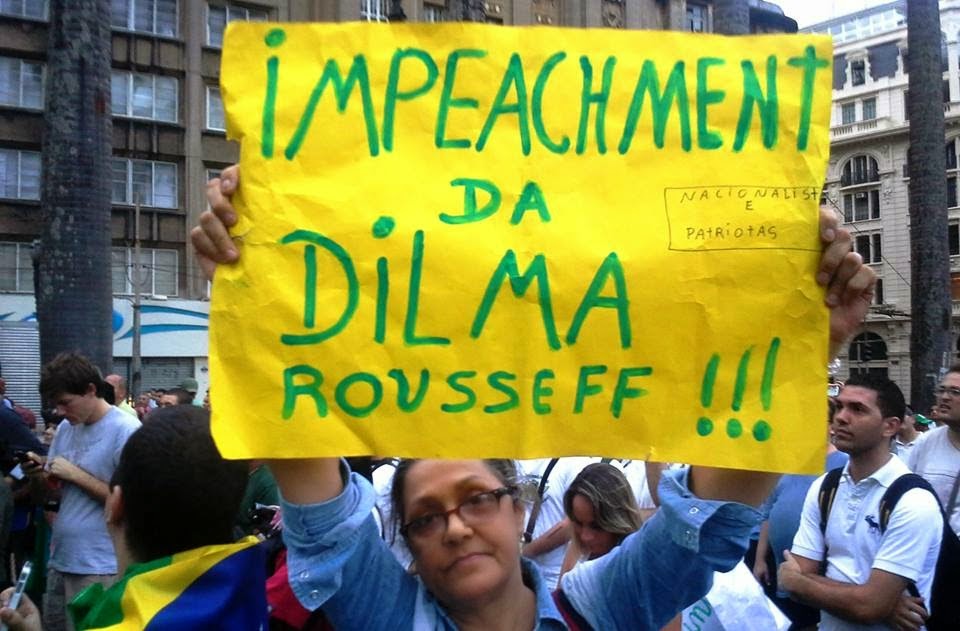 Once heralded as one of the strongest emerging economies, Brazil has seen its economic fortunes wane over the past year as a result of corruption scandals, fiscal management, and bureaucratic incompetence. The nation is in the midst of a recession – the longest downturn since the 1930s – and unemployment is nearing double digits. As if this was not bad enough, Brazil’s Congress is moving to remove President Dilma Rousseff on charges that she violated Brazil’s fiscal management laws by manipulating government finances to aid her re-election campaign last year. Congress may also move to look into whether Rousseff played any part in a scandal at the state-owned oil company Petrobras, as she was Brazil’s energy minister in former President Luiz Ignacio Lula da Silva’s government. While some investors have welcomed the move to impeach Rousseff – viewing her as an obstacle to sound economic management – other analysts worry that the impeachment controversy will be an unwelcome distraction as Brazil attempts to correct its present economic trajectory. Rousseff’s defenders argue that her prosecution is politically motivated and that Speaker Eduardo Cunha only initiated the proceedings after Rousseff’s Worker’s Party (PT) moved to oust him on charges of bribery and money-laundering.
 Here is today’s premium R&D to accompany
  Here is today’s premium R&D to accompany