



[fblike]
Two weeks ago, terrorists from the Somali al-Qaeda affiliate al-Shabab entered the Westgate Mall in Nairobi, Kenya and after telling all Muslims to leave began firing indiscriminately on those that remained. After a four day siege, the Kenyan government’s forces took out the militants, ending the worst terrorist attack that Kenya has seen since the bombing of the U.S. embassy in 1998 that killed more than 200 people. At least sixty-one people died in the attack and nearly 200 were wounded. The Red Cross also estimates that there are more than sixty people missing, some of which are feared dead after several mall floors collapsed during the final hours of the siege. Al-Shabab says that the justification for the attack is Kenya’s occupation of Somali territory and they have pledged to continue their attacks. The issue is further complicated by Kenya’s president and vice-president standing trial at the International Criminal Court (ICC) this fall.
This topic brief will provide some background information on al-Shabab and their hostility toward the Kenyan government, discuss the Westgate shopping mall attack, and examine what lies ahead for Kenya’s struggle with the al-Shabab terrorist group.
Readers are also encouraged to use the links below and in the related R&D to bolster their files about this topic.
 By October 1st Congress must pass legislation to fund the annual expenses of the federal government for the next fiscal year. If it does not, a government shutdown will ensue where many government operations will cease, although programs that do not receive their funding directly from the Treasury, provide for national defense, or conduct essential services will continue. Speaker of the House John Boehner (R-OH) hoped to avoid a showdown with the White House in what would be the first fiscal showdown since 2011, but Tea Party Republicans have pressured he and other members of the House Republican leadership to pass a spending measure that would fund the government in the short-term and deny funding for Obamacare, which is set to begin on October 1st with the opening of signups on state insurance exchanges. President Obama and Senate Democrats argue that the spending measure passed by the House is a non-starter and if a compromise is not reached by October 1st it would result in the first government shutdown since 1995-1996. The battle over the shutdown also touches on the nation’s credit rating, since the debt ceiling will have to be raised to avoid a potentially damaging default.
 Since 1979, when Egypt was a signatory to the Camp David Accords with Israel, whereby Egypt normalized its relations with Israel in exchange for the Sinai Peninsula, the United States has maintained strong military and diplomatic ties with the Egypt. Today, the United States government provides an estimated $1.5 billion in aid to the Egyptian military. American foreign policy views Egypt as a bulwark against unrest in the Middle East and a constructive player in the Israeli-Palestinian dispute. However, that foreign policy view left the United States backing Egyptian strongmen like former President Hosni Mubarak, who ruled the country under a state of emergency for nearly thirty years. The Arab Spring in Egypt in 2011 ousted Mubarak and brought to power the Muslim Brotherhood, an Islamist political organization and religious social organization, which had been declared an illegal organization after it was accused of trying to assassinate Egyptian Prime Minister Gamal Abdel Nasser in 1954. After being unable to stabilize the country politically or economically, protests against the Brotherhood’s rule were launched in June, which culminated in a military coup on July 3rd that installed a provisional government headed by Supreme Constitutional Court Chief Justice Adly Mansour. In light of the military government’s recent crackdown on sit-ins launched by the Brotherhood six weeks ago to pressure the provisional government to step down, which caused the deaths of at least 600 people, the United States and the Egyptian governments are in a tricky situation. Should the U.S. end its military aid to Egypt and risk alienating its governing authorities? How would that affect the geopolitical situation in the Middle East? Also, what is the effect of this unrest on Egyptian society and is there a way for the Egyptian provisional government to put the country on the path towards peace, prosperity, and political reconciliation?
 On July 18th, Detroit filed for bankruptcy, making it the biggest municipal default in American history. Contemporary observers of the city would be hard pressed to tell that it was once one of the fourth most populated cities in the country and produced three-quarters of America’s war machine in the Second World War. Detroit’s bankruptcy has been decades in the making, a consequence of political corruption, deindustrialization, globalization, “white flight,” and poor budgeting. Given that Detroit’s tenure in bankruptcy court will likely last until the end of 2014, if not beyond, extempers will face a host of questions this season about how Detroit got to this point, how it can fix its debt, whether the federal government should come the assistance of the beleaguered city, and what impact its bankruptcy may have on the rest of the United States, namely those cities who are approaching the same fiscal cliff that Detroit has already driven off of.
 Judicial issues is a topic area that United States extempers face, usually at NFL Districts and the NFL National Tournament, although it is also a topic that can find itself used at local and state tournaments as well. The judicial branch is one of the three branches of the U.S. national government and plays a vital role in defining the U.S. Constitution and weighing in on heated political, social, and economic issues. This topic brief will break down some of the major issues that extempers might have to discuss on the judicial issues topic area and things they want to keep in mind when answering these questions.
 Until early November, extempers can expect to run into lots of questions about the midterm elections. These questions may ask you which party will win the elections, what the biggest issue in the elections is going to be, or about specific races happening throughout the country. Usually, if you get a question about a specific race it will be about a Senate or governor’s race because those typically attract more attention than House races. Extempers should have files on the major races and get to know the candidates in those races. To get an idea of what the major races are, extempers should go to the Cook Political Report or Real Clear Politics and see the races that are classified as “tossups.” The “tossup” label designates races where the Democratic and Republican candidates have a chance to win. If you are new to extemp, you will see this labels again in 2012 for the presidential campaign.
 Once the midterm elections end, the next big political campaign will be the 2012 presidential election. While President Obama will likely be nominated by the Democrats for a second term, the Republican opposition has no clear frontrunner. Based on the midterm election cycle, the GOP presidential primary might be one of the most thrilling and competitive in years and might see a bloody civil war between social and fiscal conservatives. Such a battle has the potential to either strengthen the party and the candidates involved or devastate the GOP’s 2012 chances.
 In Supreme Court Work, Early Views of Kagan
 N.Y. Republicans Tap Lazio as Candidate for Governor
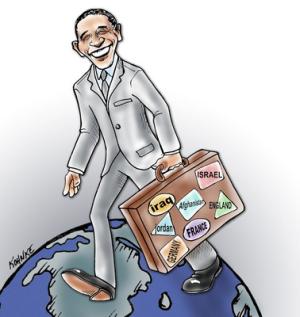 US hegemony in Middle East is ending
 Bernanke says global recovery depends on emerging markets, central banks
 Poll Shows Paul Still Leads in Kentucky
 California’s Budget Crisis: Greece is the Word