

 If any extempers thought that the removal of the Bush administration would see a reduction in international tensions they have been proved wrong by the recent tensions on the Korean peninsula that continue to rise daily. The North Korean regime of Kim Jong-Il, known for its inability to refrain from shining the international media spotlight on it for too long, is threatening to launch a long range missile, called Taepodong 2 or Paektusan 2, which it claims is actually a rocket meant to send a satellite into space.
International pundits are worried about the fallout of this missile launch. Whether or not the missile launch succeeds is not as much of an issue as whether or not North Korea launches the missile at all. U.S. Secretary of State Hillary Clinton has warned that if North Korea proceeds with this launch, which North Korea says will come between April 4th and 8th, it could lead to the destruction of the six party talks concerning North Korea’s nuclear program and leave it more isolated than it was before. North Korea, for its part, says that it would consider any attempt to interfere with this launch as an act of war, which could have very negative ramifications for the entire East Asia region.
This brief will provide extempers with the details of why North Korea may be launching this missile, international reaction to North Korea’s plans to launch this missile, and how a successful missile launch could impact U.S. and international policy towards North Korea.
 Throughout much of the last week, the U.S. media has been obsessed with the bonuses that American International Group (AIG) was planning on paying its executives. Corporate bonuses are regularly scrutinized by the media as a way of the richer getting richer, but these carry with them special weight due to the fact that AIG has received over $170 billion in government bailout funds due to the financial crisis that began last September. With bonuses over $100 million set to be rewarded to executives who have been ridiculed for their incompetence during the crisis, the American people are outraged that some of their taxpayer dollars may go to filling the pockets of Wall Street executives as opposed to people who are without employment or who might lose their jobs in Detroit’s automotive plants.
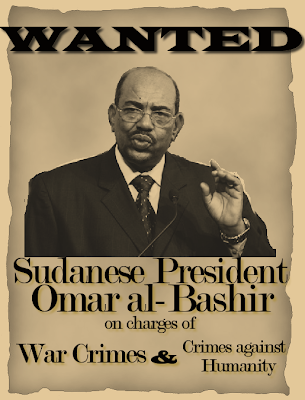 The International Criminal Court (ICC) issued its largest arrest warrant to date when last Wednesday they targeted Sudanese President Omar al-Bashir on charges of war crimes and crimes against humanity for actions that have taken place in Sudan’s Darfur region from 2003-2008. Bashir is alleged to have provided support and ordered the violence in that region of the country which has left over 300,000 people dead and displaced up to 2.5 million people. Due to the actions of Sudan’s Arab population in killing blacks farmers in Darfur, there has also been charges of genocide leveled against Bashir’s regime, although the ICC decided not to issue an arrest warrant with that charge attached.
 Shortly after getting Congress to pass his economic stimulus bill, worth $787 billion, Barack Obama has again presented Congress with his plan for the federal budget for next year. Under our constitutional system, the President has the responsibility to make the budget, but Congress must debate its proposals, amend it if they choose, and then vote on the final package. While the current version of Obama’s 2010 budget, worth $3.6 trillion, $1.2 trillion being borrowed, is not likely to stay in its current form, it nevertheless gives us insight into his presidential priorities and where he would like to take the country.
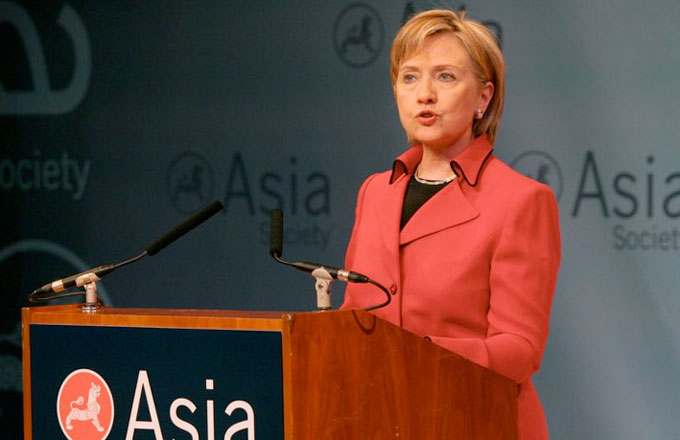 Ever since she joined Barack Obama’s cabinet as Secretary of State, insiders across the political spectrum have weighed in about Hillary Clinton’s intentions in taking the job. Was she coming on board to overshadow the new president? Was she going to try to use the position to increase her political clout and make another run at the White House in 2016, or potentially 2012 if Obama failed? Or was she going into the job in order to provide a valuable supplement to the Obama team in the foreign arena?
 The Republican Party, walloped in the last two major national elections in 2006 and 2008, is a party suffering an identity crisis. Torn between fiscal and social conservatives, the party is not sure how to best rebound and try to gain seats in 2010. After all, a divided Republican Party without a coherent national agenda may not only find it difficult to defend their 2010 seats, but will also find it difficult to dislodge President Obama from the White House in 2012.
 Over the last week, the news concerning the state of the U.S. economy continues to be troubling. Unemployment rates stand at the highest they have been in twenty-five years, banks continue to suffer problems despite the federal government’s willingness to give them aid, there is still doubt and uncertainty over the fate of America’s automakers, the federal deficit is expected to climb, and the gross domestic product (GDP) of the U.S. shrinking 3.8 percent in the fourth quarter, the biggest such contraction in GDP since 1982.
 Russia’s decision on January 5, 2009 to cut gas supplies to European consumers via pipelines in Ukraine has sent shockwaves throughout the European energy community. The dispute between the two countries, centering upon geopolitical issues on Russia’s western border, has plunged some European nations into a new discussion about the safety and security of Europe’s energy policy of relying on Russia for natural gas. Russia’s President Dmitry Medvedev and Prime Minister Vladimir Putin are still trying to test the West’s resolve against a somewhat resurgent Russia and are acting more aggressively now that some spots of protest has risen against their rule at home in light of the current economic problems facing the world.
 Just when the drama in Illinois concerning Rod Blagojevich seemed to be running out of steam in the national press, the controversial and indicted governor gave it new momentum by defying Senate Democratic leaders and state lawmakers and appointing Roland Burris, a former state attorney general and former political primary opponent, to Barack Obama’s vacant U.S. Senate seat.
 When the incoming presidential administration of Barack Obama considered what foreign policy challenges they might face in the first few weeks of office, it is fair to say that the Israeli-Palestinian conflict was not at the top of the list. With international analysts warning of how close Iran is to having the capability to build a nuclear weapon and with the latest military moves by Pakistan along the Indian border, Obama’s transition team envisioned conflicts, but not one that has the potential to ruin much of the international goodwill Obama brings with him into 1600 Pennsylvania Avenue.
 Last week, when it appeared that the Obama presidential transition would proceed as smoothly as possible in the midst of economic turmoil, two foreign wars, and a crisis of relations between India and Pakistan, the entire U.S. political climate was shaken to its core by the arrest of acting Illinois Governor Rod Blagojevich. The controversy has been a distraction for the incoming Obama administration and his transition team has been beating a quiet message for the media, while circling the wagons to prevent any negative political fallout. The incident has also put into question Obama’s economic plan, worth up to $1 trillion, and has the implication of eventually altering the makeup of the U.S. Senate, at a time when Democrats assumed that Obama’s successor would be a Democratic candidate.
 While Canadian politics is not a topic that extempers are accustomed to speaking about at great length, the last month has slowly began to change that evaluation. Loyal readers of the SpeechGeek HOTtopics services know that several weeks ago I wrote a topic brief concerning the outcome of the Canadian elections, elections which strengthened the Conservative Party but denied Canadian prime minister Stephen Harper a majority government. While analysts debated how long Harper’s government could hold on, and my earlier topic brief indicated that the government would last until the summer, just several weeks into its term the government has been thrown into a crisis, as opposition parties have unified to oust Harper and the Conservative government from power.