


[fblike]
Last week President Obama gained a much needed diplomatic victory when he and Chinese President Xi Jinping announced a bilateral climate change deal. The non-binding accord pledged both nations to make feasible steps in reducing carbon dioxide (CO2) emissions and lays the foundation for environmental cooperation. It creates the first cap of Chinese CO2 emissions – the highest in the world – and may eventually produce a comprehensive global climate deal in Paris next year. While some climate activists praised the deal, others warned that it did not go far enough. Republicans argued that the deal will present another workaround of Congress and hurt the American economy. Other nations, especially those who have resisted caps on CO2 emissions, remained mum about the accord.
This topic brief will discuss the tenets of the China-U.S. climate deal, the challenges and difficulties of making it work, and how the deal may impact the world’s ability to produce a new climate deal by the end of 2015.
Readers are also encouraged to use the links below and in the related R&D to bolster their files about this topic.
 Last Sunday, Brazilian voters went to the polls and re-elected Dilma Rousseff by the slimmest margin since the country reverted back to democracy in the 1980s. Rousseff, aligned with the leftist Workers’ Party (PT) defeated center-right candidate Aecio Neves of the Brazilian Social Democracy Party (PSDB) in the runoff election by a three point margin, 51.64% to 48.36%. The results show that the country is divided between its poorer, more dependent northern regions and its more prosperous, middle-class southern regions. Rousseff has promised to do more to clean up corruption, enact political reform, and rejuvenate Brazil’s ailing economy, but her campaign pledge to maintain generous social benefits and the nastiness of the general election campaign may hinder her ability to do any of these things. Since Brazil has the seventh-largest economy in the world and is part of the BRICS nations extempers should be prepared to discuss the country’s economic problems and the outcome of the presidential election at future tournaments.
 Last week Canada was rocked by two terrorist attacks. On Monday, Martin Couture-Rouleau drove his car into two Canadian soldiers in Saint-Jean-sur-Richelieu, killing one of them, and on Wednesday, Michael Zehaf-Bibeau killed a soldier guarding the National War Memorial in Ottawa and wounded a guard in the Canadian Parliament. Both men were killed in their attacks and were recent converts to Islam. Canadian Prime Minister Stephen Harper argued that the actions of Couture-Roleau and Zehaf-Bibeau were inspired by the Islamic State, which has urged its followers to attack Western nations. Harper plans to push for legislation that would grant more powers to Canadian intelligence services and strengthen authorities in anti-terrorism operations, but his opponents argue that these security reforms could do significant damage to Canadian politics and culture. These Canadians worry that Harper will push anti-terrorism measures too far and that their country will eventually have the same intrusive surveillance systems as the United States and Great Britain.
 Two weeks ago, citizens of Hong Kong took to the streets to agitate for universal suffrage. In 2017, Hong Kong will be able to elect its chief executive, but the candidates for that office will be approved by a nominating committee that is sympathetic to mainland China. Once a British colony, Hong Kong reverted back to Chinese rule in 1997. Since that time it has agitated against the Chinese government’s attempts to impose greater control over some of the city’s affairs. The recent protests have caused some observers to remark that there are parallels between the agitation for wider democracy in Hong Kong and the aims of the Tiananmen Square protesters of 1989, who sought to turn China into a democratic republic. China violently suppressed the Tiananmen protests over two decades ago, but doing the same in Hong Kong could do significant damage to the country’s international reputation and economic standing.
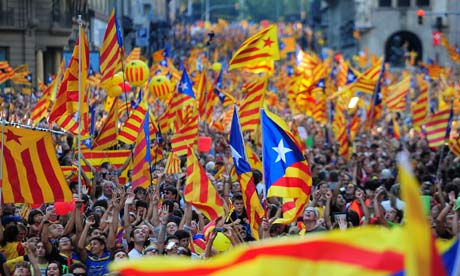 Although the Scottish independence referendum failed last week, the cloud of secession still looms over Europe. Catalonia, a region located in Northeastern Spain, is pushing for an independence referendum. Catalans view their culture as separate from that of the larger Spanish state and the country’s economic problems have led growing numbers of Catalans to conclude that they would be better off if they went their own way. A day after the Scottish independence referendum failed, Catalonia’s regional parliament authorized Catalan President Artur Mas to call a “consultation” (a fancy name for a referendum) on independence. The Spanish government, headed by Prime Minister Mariano Rajoy, says that a Catalan independence vote would violate the Spanish Constitution and they have vowed a legal challenge to the measure. Since the Catalan secession issue might drag out for the remainder of the year, extempers should be prepared to talk about the subject at tournaments.
 Arguably no other country in Latin America has defined the region’s shift to the political left like Venezuela. Embarking upon a socialist revolution under former President Hugo Chavez in 1999, the country spread its left-wing policies to other nations such as Nicaragua, Peru, and Bolivia. Under Chavez, Venezuela nationalized foreign businesses, bought international allies with subsidized oil, and became a vocal critic of American foreign policy. Unfortunately, poor economic decisions laid the foundation for the country’s current economic mess. President Nicholas Maduro has thus far shown himself ill-equipped to make the hard choices necessary to rescue the economy from inflation and a heavy reliance on imports. Since the failure of the Venezuelan economy would indict the cause of Bolivarian socialism throughout Latin America, it is imperative that extempers continue to follow Venezuela’s economic difficulties.
 In less than two weeks, Scottish voters will head to the polls to decide whether to sever their 307-year relationship with the United Kingdom. The referendum is the culmination of decades of agitation by the Scottish National Party (SNP) and mirrors events taking place across the European continent by people who no longer associate with large, multicultural states. If Scotland decides to become independent on September 18 it could significantly weaken the defense posture of Great Britain, while simultaneously motivating other independence movements in continental Europe. An independent Scotland would face sizable economic problems, though, and concerns about those issues could help the “no” forces with the upcoming referendum.
 When Nawaz Sharif became the Prime Minister of Pakistan last year international observers thought the country was heading down the right path. For the first time in Pakistani history power was peacefully passed from one democratically elected government to another. Sharif’s government made tackling corruption and high unemployment a priority. It also sought to rein in the power of the Pakistani Army, which still seeks to execute a veto of internal security measures and foreign policies. Unfortunately, Sharif’s government now finds itself under siege from political protesters that are demanding its removal. Led by two minor politicians, these forces allege that Sharif’s government illegitimately came to power in a fraudulent election and that it is too corrupt to lead. Protesters are blocking government buildings in the capital city of Islamabad and the unrest might give the Pakistani military an excuse to topple the civilian government, something that the military has done three times previously in the country’s history.
 Of all of the known deadly pathogens in the world, few are as scary as the Ebola Virus Disease (EVD). With a 90% fatality rate, the hemorrhagic fever has spread to three West Africa countries since it was discovered in Guinea in February. To date, the virus has infected more than 1,400 people and killed more than 700. The United States, the European Union, and Asian nations are watching the Ebola outbreak closely and have ramped up security at their international airports to deal with the contagion. Due to the fact that medical experts believe it will take several months to bring this recent Ebola outbreak under control, extempers should be prepared to talk about it in the first few months of the 2014-2015 season.
 Iraq has largely stayed under the radar during the 2013-2014 extemporaneous speaking season, which is a far cry from when the country was the focal point of many rounds between 2002 and 2008. However, on the eve of this year’s National Speech and Debate Association (NSDA) National Tournament, Iraq has come back into the public eye in light of the collapse of the Iraqi Army in Mosul and Tikrit. The Islamic State of Iraq and Syria (ISIS), also known as the Islamic State of Iraq and al-Sham (ISIL), forced the Iraqi Army to flee last week and are now threatening to capture Baghdad, the Iraqi capital. The ISIS, who have been active in the Syrian civil war and aim to create a Sunni caliphate that encompasses territory from both countries, could threaten Middle East instability, lead to the partition of Iraq, and have a negative impact on global oil markets.
 On June 2, the Environmental Protection Agency (EPA) unveiled new regulations to limit America’s carbon dioxide (CO2) emissions. Using provisions of the Clean Air Act of 1970, which require the EPA to regulate pollutants, the EPA has laid out a series of regulations designed to reduce U.S. carbon emissions by 30% from 2005 levels by 2030. Successfully doing so will help America maintain its international commitments to reduce its carbon emissions and the Obama administration and environmental forces believe that it will encourage other nations to take action on climate change. Opponents of the EPA regulations argue that they unconstitutionally strip regulatory control of carbon emissions from Congress and warn that they will harm the nation’s economy. Since the EPA regulations will go into effect over the next four years, extempers should be prepared for questions about their implementation and effectiveness.
 Elections for the European parliament, which took place from May 22 to May 25, were deemed as a political earthquake. Parties that were anti-European Union (EU), anti-immigration, and pro-Russian won sizable vote shares across the continent, especially in Western Europe, and significantly increased their representation in the new European Parliament. In France and Great Britain, far-right political parties defeated more moderate liberal and conservative parties and illustrated that predicting future electoral outcomes in these countries will not be easy. Since the parties of the far-right have largely been ostracized in the past due to Europe’s experiences with far-right forces in the lead up to the Second World War, their recent rise has focused attention on the continent’s economic and social problems and put the future of European integration in doubt.
 For the last six months Thailand has been in the midst of a political crisis. Two weeks ago on May 7, Thailand’s Constitutional Court ordered the removal of Yingluck Shinawatra as the nation’s prime minister. Shinawatra’s supporters, who also followed her brother Thaksin, a telecommunications billionaire that served as the nation’s leader from 2001-2006, are rural and poor. Middle-class and professional Thais look down on Shinawatra’s supporters and believe that Thailand’s political system is rigged against them. As a result, they have taken to the streets against the Shinawatras and the remaining members of the existing government, choosing to go outside of normal political channels and undermine existing political institutions. The current environment is causing analysts to worry that political tensions could produce a civil war or, at the very least, drag the Thai economy into recession.
 The citizens of South Sudan, the world’s youngest country, have had their daily lives disrupted by a civil war since December. The war, waged between two political factions that break along ethnic lines, has escalated in recent months and brought back memories of the Rwandan genocide of 1994. The war threatens the country’s oil-based economy, the stability of central Africa, and risks creating a humanitarian disaster. Since South Sudan won its independence through a civil war that lasted more than two decades, it is tragic that it has become the most recent global victim of civil unrest and the international community is struggling to contain the violence and provide assistance to people in need. Due to the fact that the situation in South Sudan is more likely to get worse over the coming months, extempers should be prepared to talk about South Sudan’s woes as they are likely to headline any African or international organizations round.