

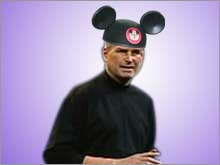
Photo Illustration/CNN
by Corey Alderdice
When Steve Jobs joined Disney’s board of directors with the Mouse-Ears Company’s acquisition of Pixar, the company hoped Jobs work a bit of that Apple magic for them as well.
With Jobs’ insight and blessing, Disney intends to borrow heavily from Apple’s playbook and their Apple Retail Stores in a forthcoming update to the Disney Store chain.
It’s not just about new shelves and a fresh coat of paint. As many stores are just trying to get by amid slumping sales, Disney is rushing toward a major investment. The key is not so much a change in product, but the actual experience of shopping at a Disney store. After all, the company that’s all about entertaining your family at the movies, on Broadway, and in theme parks worldwide might as well have your attention at the local mall. The New York Times explains:
Disney Stores, which the media giant is considering rebranding Imagination Park, will become more akin to cozy entertainment hubs. The chain’s traditional approach of displaying row after row of toys and apparel geared to Disney franchises will be given a high-tech makeover and incorporated into a new array of recreational activities. The goal is to make children clamor to visit the stores and stay longer, perhaps bolstering sales as a result. Over the next five years, analysts estimate that Disney will spend about $1 million a store to redecorate, reorganize and install interactive technology.
“The world does not need another place to sell Disney merchandise — this only works if it’s an experience,” said Jim Fielding, president of Disney Stores Worldwide. The company plans to unveil the new look in May in Southern California, Long Island and Madrid, and is close to signing a lease for that Times Square flagship.
Where does this fit into your speech? As the recession lingers, questions about the economic outlook will find themselves into each tournament. Moreover, as we approach what is expected to be another glum holiday shopping season, questions will pop up about the retail outlook. You might even work this into a speech about reinvention, the need to try something new, or other situations where change is happening in business or industry.
 By Logan Scisco
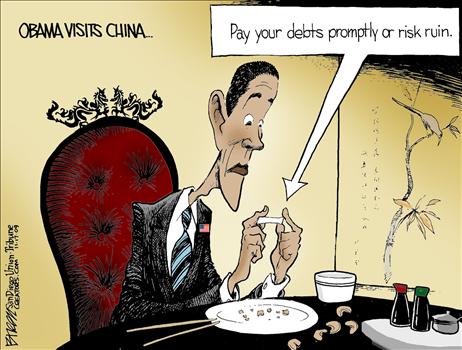 During the “off season” after NFL Nationals, the issue of the budget deficit has come to be a major one in American politics. It has the potential to shape the outcome of the midterm elections in 2010 and is playing a role in President Barack Obama’s declining popularity ratings. As extempers get ready for the 2009-2010 season, which starts in less than six weeks with the Wake Forest National Early Bird, they will face questions about an array of economic issues such as unemployment, the effectiveness of the stimulus package, and the level of international trade as well as the controversial issue of healthcare reform. All of these issues have something to do with the budget of the United States government and by proxy the deficit the U.S. government currently finds itself facing.
 Throughout much of the last week, the U.S. media has been obsessed with the bonuses that American International Group (AIG) was planning on paying its executives. Corporate bonuses are regularly scrutinized by the media as a way of the richer getting richer, but these carry with them special weight due to the fact that AIG has received over $170 billion in government bailout funds due to the financial crisis that began last September. With bonuses over $100 million set to be rewarded to executives who have been ridiculed for their incompetence during the crisis, the American people are outraged that some of their taxpayer dollars may go to filling the pockets of Wall Street executives as opposed to people who are without employment or who might lose their jobs in Detroit’s automotive plants.
 Shortly after getting Congress to pass his economic stimulus bill, worth $787 billion, Barack Obama has again presented Congress with his plan for the federal budget for next year. Under our constitutional system, the President has the responsibility to make the budget, but Congress must debate its proposals, amend it if they choose, and then vote on the final package. While the current version of Obama’s 2010 budget, worth $3.6 trillion, $1.2 trillion being borrowed, is not likely to stay in its current form, it nevertheless gives us insight into his presidential priorities and where he would like to take the country.
 Over the last week, the news concerning the state of the U.S. economy continues to be troubling. Unemployment rates stand at the highest they have been in twenty-five years, banks continue to suffer problems despite the federal government’s willingness to give them aid, there is still doubt and uncertainty over the fate of America’s automakers, the federal deficit is expected to climb, and the gross domestic product (GDP) of the U.S. shrinking 3.8 percent in the fourth quarter, the biggest such contraction in GDP since 1982.
 Extempers have been busy over the last several months trying to understand the different elements of the current financial crisis. In the midst of understanding credit markets, bond markets, the $700 billion U.S. bailout package, and deteriorating housing market, it was easy to ignore the problems of one of the most crucial industries of the U.S. economy: the auto market. Within the last several weeks, the problems of the auto industry’s “Big Three”, General Motors (GM), Chrysler, and Ford have become dire, as the auto companies say they have spent most of the $15 billion they held in reserve during the third quarter. Faced with slumping sales at home and in the midst of restructuring their operations, GM has warned that without government aid it will not be able to make it through the year and Ford has warned that it will not last long into 2009 without government aid.
 Overview
 Overview
 Overview